Macos Skin For Classic Shell
Posted : admin On 17.12.2020For most macOS installations, this is the default shell. This means that all settings are going to be kept in a.bashprofile file. So any time you want to add anything to your path, this is the file into which it’s written. Required Cookies & Technologies. Some of the technologies we use are necessary for critical functions like security and site integrity, account authentication, security and privacy preferences, internal site usage and maintenance data, and to make the site work correctly for browsing and transactions. Find a MacBook decal skin that fits your MacBook model & style. From MacBook Pro to MacBook Air, Skinit offers the best vinyl decal skins for any MacBook. Not that I badly want to enable the classic startup chime on newer Macs, I have indeed missed this unique sound ever since Apple removed it in 2016. While a few hacks about getting the chime back on macOS surfaced online, their joy was short-lived as macOS updates rendered them useless.
- Macos Skin For Classic Shell Casings
- Macos Skin For Classic Shell Shockers
- Macos Skin For Classic Shell Cordovan
- Macos Skin For Classic Shell Scripting
If you’ve read any instructions on the web for how to install something, you’ve likely read a statement about adding something to your $PATH. More specifically, it probably included an export statement, a directory, and then a file into which to pipe the command, right?
In fact, you may see a directive like this:
Make sure the ~/.composer/vendor/bin directory is in your system’s “PATH”.
Classic Shell adds some missing features to Windows 7 and Vista like a classic start menu, toolbar for Explorer and others. Different skins for the start menu. Open Classic Shell settings by right clicking the Start button and go to the Skin tab. Select the 'Winaero' skin. The first option lets you disable the transparency for use with an opaque taskbar. With the help of MAC Skin pack you will able to change the look on your Windows 8 PC in to Macintosh. If you are bored with the look of Windows 8 than you have to try Mountain Lion Skin Pack for Windows 8 and transform Windows 8 into Mac OS X.
Which means that you should do something like the following:
But if you’re new to working in the terminal, let alone environmental variables, how are you supposed to know how to translate the statement into the above command?
Shells in macOS
Before getting into what a shell is, it’s important to note that the terminal is basically the way to access the file system through a series of commands and text-based programs.
They’re popular especially in *nix-based operating systems, through Windows has it, too (if you ever used MS-DOS or the Command Prompt then you know what I mean).
For this post, I’m primarily talking about *nix-based systems and, even more specifically, macOS. So when it comes to talking about shells in macOS, you’re talking about the program that interprets the commands entered into the terminal.
That’s all, nothing fancy.
So what are Frontier season 2 download torrent. adobe air 3 mac download the different shells in macOS? There are typically four shells that come with the operating system (though you can install more, if you like).
macOS Shells
These shells include bash, ksh, tcsh, and zsh. Noe that some people will claim one shell is better than the other whereas others (like myself) are a bit ambivalent. I tend to stick with Bash since that’s what I’ve used the longest and know the best (though I will say Oh My Zsh., which I’ll cover momentarily, has been nice to tinker with, too).
For most macOS installations, this is the default shell. This means that all settings are going to be kept in a .bash_profile file. So any time you want to add anything to your path, this is the file into which it’s written. There are other files, but they are outside the scope of this post.
Understanding Profiles
Whenever you’re working in a terminal and you make a change to the file associated with that terminal session (that is, the instance of the terminal you have open), you have tell the operating system to load those changes via the following command:
…where ~/.profile is the shell’s profile file. Note, however, that for many shells this is only consistent for the session of the terminal. It does not mean that it will persist the next time you open the terminal let alone your operating system.
This is because a given shell may have a hierarchy, so to speak, of files. For Bash, this includes .bashrc, .bash_profile, and .profile. Furthermore, you may be able to define the settings in your operating system’s Terminal settings.
For example, if you’re using Linux:
If, on the other hand, you’re using macOS, then you’d need to use one of the aforementioned files. Using bash as an example, I’ll break down how they all fit together:
- .profile is the login script. If one doesn’t exist, you can create one and this will execute the commands you have upon login to the session. If you want to have something execute or something available just during login, this is the file. This is also system-wide.
- .bashrc is a file that’s read during a terminal session (or even when the GUI is being used). Think of this is both login and interactive. So if you want something available during login and when using the OS, this is a file you can use.
- .bash_profile is available run during login and it’s dedicated towards an individual’s account.
Is There More?
Since this is a quick guide, yes, there’s more. You can read them in the man page specific to your terminal. For bash, simply enter
In your terminal and you’ll be given the complete guide to the terminal.
As a take away, here’s what you may stumble across when it comes to the profile files:
- /bin/bash. The bash executable
- /etc/profile. The systemwide initialization file, executed for login shells
- ~/.bash_profile. The personal initialization file, executed for login shells
- ~/.bashrc. The individual per-interactive-shell sta. rtup file
- ~/.bash_logout. The individual login shell cleanup file, executed when a login shell exits
- ~/.inputrc. Individual readline initialization file
The next time you need to export a path, set a value, or work with your profile, this should hopefully give you a guide as to where the change needs to be made (and how you can do it).
Classic Shell includes one of the most popular Start menu replacements for Windows 7, Windows 8 and Windows 10 along with a bunch of unique customization options for Explorer and Taskbar. When we cover various tips and tricks related to Classic Shell, our readers often ask us about good looking Start menu skins. Today, I would like to share a collection of excellent skins for Classic Shell to style your Start menu.
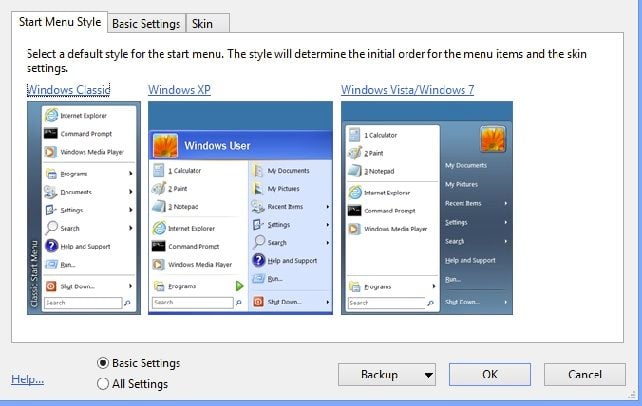
To install a skin, copy the .skin or .skin7 file to C:Program FilesClassic ShellSkins. Then open Classic Start Menu Settings and go to the 'Start Menu Style' tab. Switch to the appropriate style (Windows 7 style for *.skin7 or Classic with two columns/Classic for *.skin). After picking the style, click the 'Select skin.' blue link which will take you to the Skin tab. Pick the skin you just copied from the dropdown and adjust the skin options as required.
Here are the skins we liked.
Windows Longhorn Hillel Demo
The first skin is Windows Longhorn Hillel Demo Start Menu:
This is a retrophase skin which repeats the appearance of pre-release versions of Windows Longhorn. This operating system was never released and superseded by Windows Vista. However, its unique appearance and wonderful look still impress many people.
You can grab this skin here: [Skin7] Windows Longhorn Hillel Demo Start Menu
Plex Replay
Like the previous skin, Plex Replay uses ideas from Windows Longhorn. Plex was the default skin of Longhorn for many builds. The skin makes the Start menu look exactly it was in Longhorn.
This skins exists in boths variants.
Plex Replay for classic/classic two columns menu:
Macos Skin For Classic Shell Casings
Plex Replay for the Windows 7 style menu:
Visit the link here to get the taskbar texture. Your desktop can look like this:
Royale
Our next skin is a set of excellently reproduced Windows XP Start menus. Windows XP users might be familiar with the popular Royale skins and its Noir, Zune and Embedded variants. The 'Royale' skin pack brings them back to modern Windows versions where Classic Shell runs:
You can get it here: Windows XP Royale Skin.
Start8 Skin
Macos Skin For Classic Shell Shockers
The next skin is specially designed to fit the flat appearance of modern Windows versions like Windows 8 and Windows 10. It is simple and beautiful. It was inspired by Start8's look:
Get it here: Start8 Skin V2.5
Gray Classic
The skin Gray Classic is designed for the Windows 7 menu style of Classic Shell. It provides a dark skin which Windows 10 users with dark mode or high contrast mode will like. Definitely good work:
Macos Skin For Classic Shell Cordovan
Get it here: Gray Classic
WIN7LIKE
The skin WIN7LIKE is designed to be used with Windows 7 menu style of Classis Shell. It will look best on Windows versions which have glass, that is, Windows 7 and Windows 10. For Windows 10, it will look better if transparency for the taskbar and Start menu is turned on from the Settings app. This skin reproduces the exact look of Windows 7 Aero Glass Start menu. It is recommended to all Windows 7 fans who switched to Windows 10 but miss the classic menu's appearance:
Get it here: WIN7LIKE
Macos Skin For Classic Shell Scripting
clrSharp1 2 3
This skin can be used with Classic and Windows 7 menu styles of Classic Shell. It looks clean and nice. Initially created for the Clearscreen Sharp visual style/theme on Windows 7, it can be used in any Windows version without the mentioned theme.
If you like it, read in detail about this skin here: clrSharp1 2 3
Vista Start menu
This is an excellent replica of the genuine Windows Vista Start menu. Get it here: Vista Start menu
Tenified
This flat and modern skin in dark colors will fit the appearance of Windows 10. The author recommends adjusting Classic Shell settings as follows: /flareget-download-manager-serial-key.html.
- Enable menu glass: On
- Override glass color: On
- Menu glass color: 0A0A0A, although 000000 works nicely as well
- Glass opacity: 40
You can get it here: Tenified
Two Tone
Yet another flat skin designed for Windows 10. It reminds me of the resizable Start menu we saw in early builds of Windows 10 which was replaced with the Modern/Universal Start menu which shipped eventually. Looks great:
You can get it here: Two Tone
This is our first look at some of the best looking skins for Classic Shell. If you like them, we will follow up with more skins. What is your favorite skin? Tell us in the comments.
Advertisment